
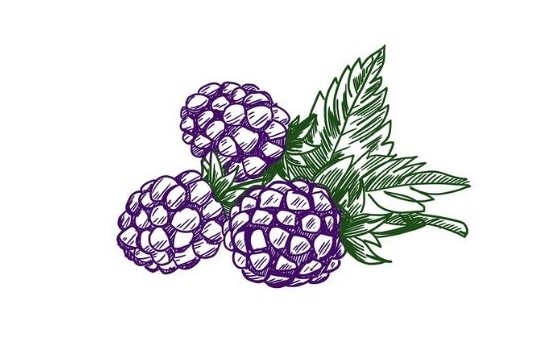
A drupe is a fleshy, stony fruit such as a cherry or a sloe, in which the pericarp is not entirely edible, unlike a berry. In the case of a drupe, the endocarp forms what we call the stone, and in many cases the outer skin (epicarp) is hard and must be removed. Therefore, it is the mesocarp, commonly known as the pulp, that is the only fleshy and edible part of the fruit.
However, among red fruits, we have a particular case found mainly in the genus Rubus of the Rosaceae family, such as the raspberry and the blackberry, which agronomically are polidrupes (drupecetum), because they originate from an apocarpous gynoecium (separate carpels) and can be eaten directly as a berry, without the need to peel or remove any skin or stone. Each of the small units that make up the fruit and contain the seeds is known as a drupeola.
So, as we explained in the question “What is a berry?”, not all red fruits are berries; we also have drupes and polydrupes.
Therefore, remember that when we speak of red fruits or forest fruits in Spanish, we are including both berries and drupes. The fact is that agronomic literature often differs from popular culture.
Prepared and written by Adrián García Villar, Agricultural Engineer from the Polytechnic University of Madrid (UPM). Membership No. 215, Official Association of Agricultural Engineers of the Principality of Asturias (COIASTUR).
References consulted:
Photo (Cherry pericarp): Own work
Photo (Drupe and drupeola):
Juan Carlos García, Guillermo García González de Lena, Marta Ciordia Ara, (2018).