
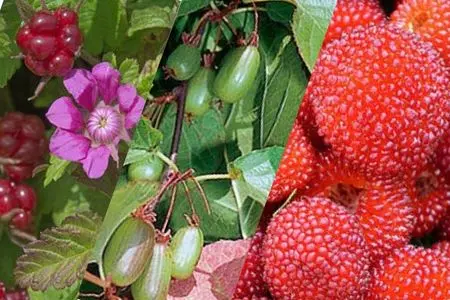
“False hybrids” are some of the least well-known soft fruits. These are plants that are mistakenly thought to be hybrids between two or more species, but in reality they are far from it, as they are pure species found in the wild.
Within the genus Rubus there are many false hybrids, mainly for two reasons. The first is its wide geographical distribution, and the second is its tendency to hybridise naturally, giving rise to countless species, some of which are very similar to one another. Sometimes, the mere fact that a plant produces fruit with an unusual or peculiar shape is enough to lead one to believe it is a hybrid.
It is common to find plants that are misclassified or misnamed online and even in books, often due to an erroneous translation from English into Spanish. In some cases, these errors become entrenched over time and end up being accepted by everyone.
If you’d like to learn the history of raspberry-blackberry hybrids, check out our blog post, where you’ll discover the thrilling race that botanists from all over the world engaged in for over a century to develop these new species.
And what are some of the lesser-known red fruits?
Well, below we’ll discuss some of them, which are mistakenly believed to be hybrids.
Japanese strawberry-raspberry (Rubus illecebrosus)
Or rather, a false strawberry-raspberry hybrid, also known as the Japanese raspberry or Tibetan raspberry, due to its similarity to the species Rubus rosifolius. This similarity has given rise to much debate and confusion regarding its origin from the late 19th century to the present day. In English, it is commonly known as Rosaline, Balloon berry or Roseberry, the latter being the translation of its original Japanese name.
The characteristic rounded shape of its fruits, with very pronounced druplets that may resemble the achenes of strawberries, gave rise to the mistaken belief that it is a hybrid between the two species, which is entirely false. Its botanical name R. Illecebrosus was given because of its visually appealing fruits.
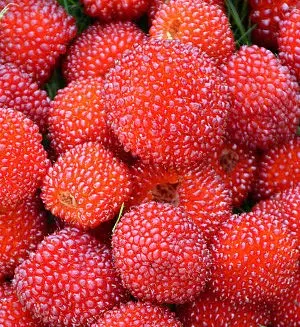
This raspberry is native to East Asia, specifically to the island of Japan, where the first wild strawberry-raspberry or Japanese raspberry plants were recorded, with two distinct varieties being identified: an alpine form native to the slopes of Mount Fuji and another from the lower-lying areas of the island, but with yellow fruit. However, there is also some controversy regarding its origin, due to the countless species of the genus Rubus found in the region, which are very similar to one another and are often difficult to classify or distinguish.
Over the last century, its cultivation has spread to other parts of the world, such as Russia, Eastern Europe and the Americas, thanks to amateur cultivation in gardens or on terraces. The commercial varieties, which have been improved over the years, are more productive and have fewer thorns than the wild forms.
Tibetan raspberry or Japanese raspberry plants are small in stature, rarely exceeding 80 cm in height; they are usually planted quite close together to form beautiful, eye-catching hedges, which are pruned back to ground level at the end of winter and sprout again the following spring.
Like all raspberries, the fruit becomes hollow once harvested, so it has a softer texture than a blackberry. Although in the case of the Tibetan raspberry the receptacle does not separate as easily as in other raspberry varieties, a characteristic that has also raised doubts about its taxonomic classification, leading some experts to question whether it is a true raspberry; in fact, it belongs to a very rare subsection of the genus Rubus, known as Xanthocarpi within the small section Cylactis.
Nor should we confuse the Japanese raspberry-strawberry with the Himalayan blackberry, which is a completely different species with the botanical name Rubus armeniacus, whose fruits are black.
Tayberry (Rubus fruticosus)
Commonly referred to as a synonym for the Tayberry, which is entirely incorrect. This error likely stems from the fact that both the Tayberry and the Tayberry were developed by the Scottish Crop Research Institute. However, the Tayberry is a recent thornless variety developed in 2002, similar to the Loch Ness variety from which it is derived, hence it is sometimes also called Loch Tay.
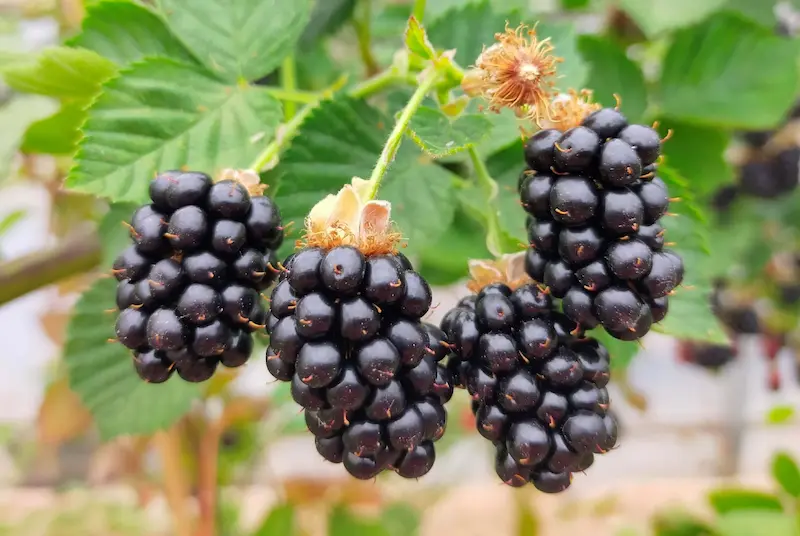
The Tayberry is characterised by a very early harvest and high quality. Like most blackberries of the species Rubus fruticosus, it is a very robust and vigorous plant, capable of producing over 3 kg per plant during spring/summer depending on the climate zone. It is a single-harvest variety, so it will only produce fruit for around four weeks, unlike the more recent double-harvest varieties, such as the ARK everbearing blackberry.
Loch Tay blackberries are of good size and flavour. When harvested, they do not detach from the receptacle, unlike raspberries, which gives them greater firmness.
Arctic raspberry (Rubus arcticus)
Also known as Arctic bramble, Nagoon berry or Nectarberry.
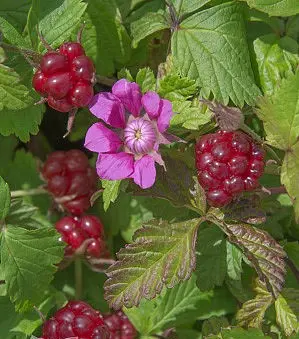
The confusion over whether it is a hybrid or not stems from the fact that, since the 1930s, the Finnish Institute of Agricultural Research has used this species to develop new hybrids, and one of the most famous is the hybrid raspberry known as ‘Nectar Raspberry’, a cross between the Arctic raspberry and the European raspberry (Rubus idaeus), and the use of the word “nectar” has caused quite a bit of confusion.
Furthermore, most varieties are not self-fertile, so we must combine two different varieties for pollination. However, in its natural habitat, its flowers are sometimes pollinated by the species Rubus saxatilis (the stone bramble), demonstrating the ease with which the Rubus genus hybridises naturally.
The Arctic raspberry, or nectarberry, is native to parts of the European Arctic, but also to other regions of Asia, Alaska and some US states such as Minnesota.
It is extremely well-known in Scandinavian countries and the Lapland region, sharing popularity with its cousin, the cloudberry (Rubus chamaemorus). Its natural habitat consists of soils rich in organic matter and with good moisture levels, such as wet meadows, lakes, peat forests or riverbanks.
Arctic raspberry plants are very low-growing and small, reaching no more than 20–30 cm in height. And, like the Tibetan raspberry, they are usually planted very close together to form attractive ground cover in the garden or orchard.
It is also characterised by producing beautiful violet-coloured flowers, similar to those produced by the salmon raspberry (Rubus spectabilis). In the northern United States, it is sometimes confused with the dwarf raspberry species Rubus pubescens, but the latter produces white flowers.
Arctic raspberries are small but delicious and very juicy, turning a purplish-red colour when ripe; they also have a very distinctive aroma reminiscent of pineapple. Because they are so small and become hollow when picked, they are very delicate and do not have a long post-harvest life; for this reason, they are widely used in baking, for making jams, and also in beverages such as liqueurs or wines.
Their leaves and flowers are commonly used to make tea.
Arctic Beauty (Actinidia kolomikta)
These mini kiwis or kiwiberries are native to East Asia. Due to the small size of their elongated, smooth-skinned fruits, it is often believed that they are a man-made hybrid, which is entirely false, as they can be found growing naturally in the forests of Japan, Korea, China and some parts of eastern Russia. The species Actinidia kolomikta is far less well known than its cousin, the species Actinidia arguta, from which most commercial varieties of mini kiwi or kiwiberry are derived.
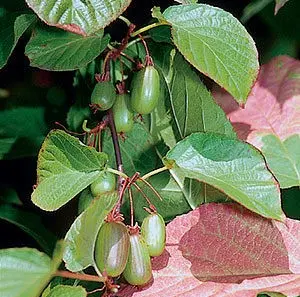
Actinidia kolomikta plants are known as Arctic Beauty or Siberian kiwi, whilst in English they are known as Hardy kiwi and in Japanese as Miyamatatabi.
They are fast-growing and very hardy plants, capable of withstanding temperatures as low as minus 40 degrees and easily growing to over 3 metres in height. They are characterised by their tricoloured leaves—green, pink and white—which will adorn our gardens or terraces. However, these tricoloured leaves do not usually appear until the second or third year after planting, and are more common on leaves exposed to full sun.
The varieties of Actinidia kolomikta, known as Arctic Beauty, have beautiful white flowers which, in some varieties, also have a hint of lemon scent. And although these plants are mainly ornamental, they also produce small, elongated fruits with edible skin that can be eaten in a single bite, although their flavour is not as rich as other varieties of the species A. arguta such as Geneva, Ananasnaya, Scarlet or Bingo.
As a point of interest for all cat owners, it is worth noting that these plants are hugely attractive to cats, even more so than catnip. So if you have a cat, make sure you protect your Arctic Beauty plants!
Himalayan Golden Raspberry (Rubus ellipticus)
Also known as the Asian wild raspberry or Ainselu in the local language. It is a golden or yellow raspberry native to the temperate region of the Himalayas, found in countries such as India, Pakistan, Nepal and China.
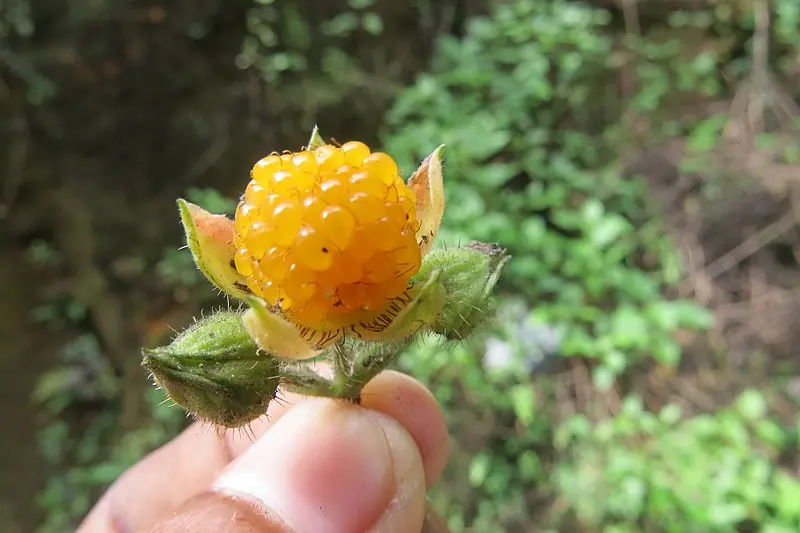
Whilst commercial yellow raspberries such as the double-cropping variety Twotimer Yellow Sugana arose from a mutation of a red raspberry (Rubus idaeus), the Himalayan yellow raspberry is a natural species found in those parts and is therefore neither a hybrid nor a mutation.
These plants are very vigorous and grow to a great height, with their thorny stems capable of reaching over 3 or 4 metres in height. They have an early flowering period, producing white flowers. Their golden-coloured fruits have a sweet taste and are often eaten by birds or elephants in the area. And, like most raspberries, they have a very short post-harvest life. The bark of the stems has been used in traditional medicine for its antidiuretic properties, whilst the juice has been used to treat colds, fever, colic or sore throats.
This species is included in the list of “The world’s 100 worst invasive species”, so do not expect to find it available on our website.
But what you will find on our website is the widest range of red berries and wild berries, and of course you can buy blackberry plants, raspberry, Arctic raspberry or Arctic beauty
Prepared and written by Adrián García Villar, Agricultural Engineer from the Polytechnic University of Madrid (UPM). Membership No. 215, Official Association of Agricultural Engineers of the Principality of Asturias (COIASTUR).
Bibliography:
Aiselu Wine
Bulletin of miscellaneous information.
Royal Botanic Gardens, Kew (1900). London: H.M. Stationery Office. (Bulletin in English)
Cesonienė, Laima & Daubaras, Remigijus & Gelvonauskis, Bronislovas, (2013).
Hummer, Kim & Finn, Chad & Dossett, Michael. (2015)
Luther Burbank’s Best Berries. HortScience. 50. 205–210. (Article in English)
Lewin, Marcus & Zhou, Mingyue & Montes, Melanie & Mattsson, Tore & Burén, Tomas & Hedrén, Mikael & Ryde, Ulf. (2022).
Stjernberg, Torsten & Carlsson, Ralf & Haeggström, Carl-Adam & Haeggström, Eeva & Sundberg, Kajsa. (2010).