
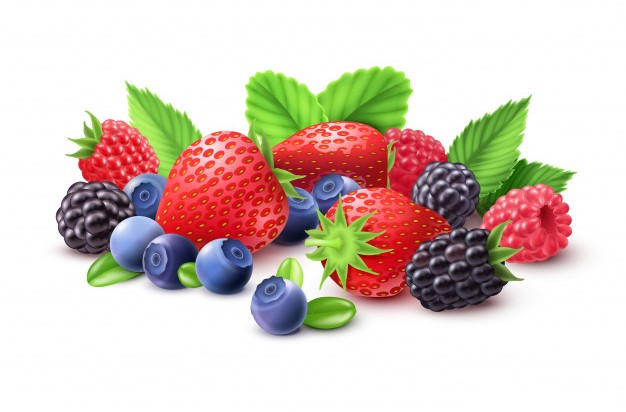
From an agronomic point of view, berries are fleshy, seedless fruits that develop from a superior ovary; in other words, both the ovary and the other parts of the flower (sepals, petals and stamens) are attached to the same point on the receptacle. The ovary gives rise to a pericarp (the part covering the seeds), which is entirely fleshy or juicy, such as in a grape, a kiwi or a tomato.
However, what springs to mind for all of us when we think of ‘berries’ are the misnamed ‘red fruits’, forest fruits or ‘berries’, which in cold or temperate climates we can gather wild from bushes in forests or mountains.
The explanation is that, because red fruits such as the blueberry, redcurrant or gooseberry originate from inferior ovaries—meaning that the floral tube and receptacle also form part of the fruit—they were agronomically classified as “false berries”, “pseudo-berries” or “unusual berries”, terms that are now largely obsolete. The main advantage of berries, apart from being delicious, is that we eat the seeds, pulp and skin in a single bite, making them very easy and appealing to eat.
It is worth mentioning that there are also some cases of red fruits that are agronomically true berries, but these are very little known.
However, not all red fruits are berries; we also find drupes such as sloes or cherries, and polydrupes such as raspberries and blackberries.
Therefore, remember that when we speak of berries or forest fruits in Spanish, they are not necessarily the same thing. The fact is that agronomic literature often has little to do with popular culture.
Prepared and written by Adrián García Villar, Agricultural Engineer from the Polytechnic University of Madrid (UPM). Membership No. 215, Official Association of Agricultural Engineers of the Principality of Asturias (COIASTUR).
References consulted:
Photo (Structure of a flower): Notes from 1st year Biology (2009)
Photo (Types of ovaries): Wikimedia Commons.
Juan Carlos García, Guillermo García González de Lena, Marta Ciordia Ara, (2018).