
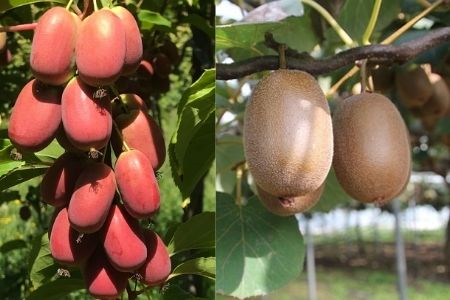
The main difference between a mini kiwi and a regular kiwi is that mini kiwis can be eaten in one bite, without needing to be peeled, thanks to their thin, smooth, hairless skin. But kiwiño fruits are also much sweeter than green and yellow kiwis; they are rich in antioxidants and minerals, which, combined with their small size, make the mini kiwi a delicious and irresistible fruit. All these characteristics mean that in English it is known as the kiwiberry.
As for the colours of the fruit, mini kiwis come in a much wider variety of colours than normal kiwis, which are only green or yellow and, more recently, red. In contrast, we can find mini kiwis with both green flesh and skin, reddish skin and green flesh, completely red skin and flesh, pink skin and yellow flesh, and even purple ones.
Like all fruits of the genus Actinidia, both kiwis and mini kiwis are climacteric fruits, meaning they continue to ripen after being picked; this is why, when found in supermarkets or shops, they are not yet fully ripe. However, whilst green or yellow kiwis can be stored in cold storage for up to 12 months, mini kiwis, due to their thin skin, have a much shorter shelf life of around 2 to 3 weeks after harvesting, or a maximum of 1 month in special storage chambers.
As for mini kiwi plants (Actinidia arguta), there are also differences compared to kiwi plants, as mini kiwi plants are hardier and more resilient, capable of withstanding temperatures as low as minus 35 degrees during winter dormancy; and thanks to their smaller size, they are much more versatile when it comes to cultivation, as we can grow mini kiwi plants on fences, trellises, espaliers or even pergolas, making them ideal for growing in our vegetable patches or gardens.
Another important difference is that we can grow and harvest mini kiwis from a single plant, as there are ‘self-fertile’ varieties such as Issai, Vitikiwi or Belleza del Ártico, which is a major advantage over growing kiwis.
Furthermore, mini kiwi plants sprout and flower around two months earlier than kiwi plants, and consequently they are harvested much earlier; it is possible to harvest mini kiwis from late July until mid- to late September, depending on the climate of each area. On the other hand, in areas with a high risk of spring frosts, we must protect the new shoots and flower buds from frost. For this reason, professional mini-kiwi plantations always install anti-frost systems, generally using water or heat, and more recently with windmills.
On our website, you can purchase the widest range of mini-kiwi plants, as well as the fruit from our organic plantation from early August to mid-September.
Prepared and written by Adrián García Villar, Agricultural Engineer from the Polytechnic University of Madrid (UPM). Membership No. 215, Official Association of Agricultural Engineers of the Principality of Asturias (COIASTUR).
References consulted:
Filip Debersaques, Piotr Latocha, Jonas Decorte, (2019).