
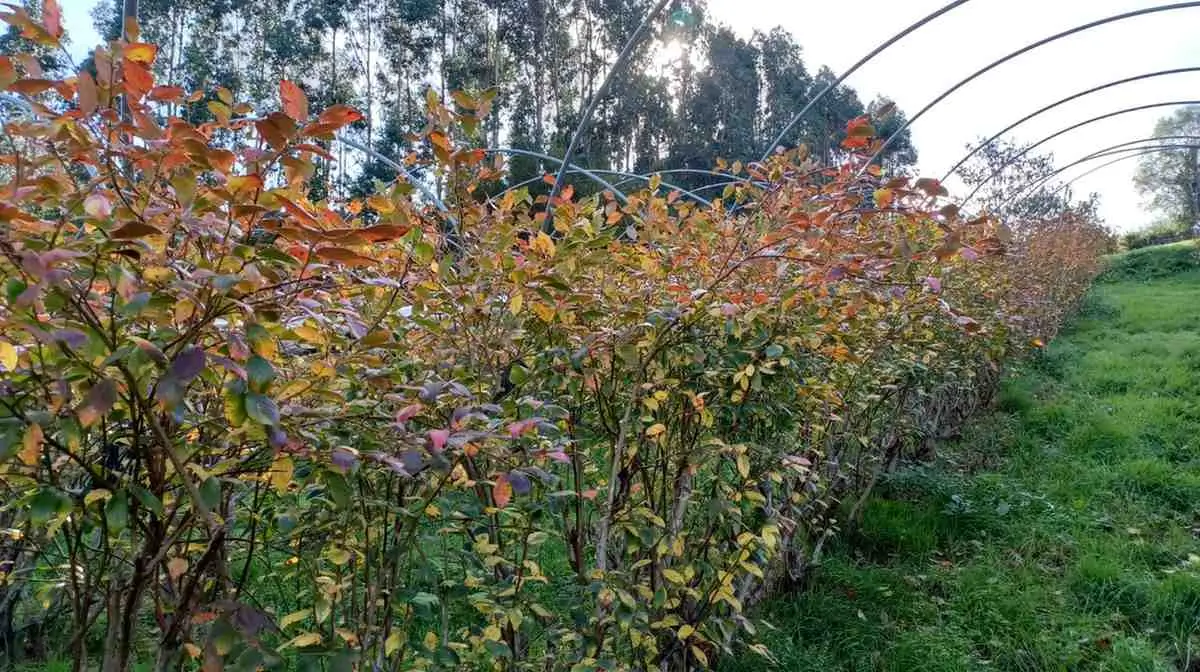
Blueberry plants (Vaccinium spp.) can range from the tiny wild species Vaccinium boreale, which grows to just 9 cm, to the impressive 9-metre-tall species known in English as the Sparkleberry or Blueberry Tree. The most widely cultivated blueberries today belong to the species Vaccinium corymbosum, commonly known as highbush blueberry, and typically grow between 180 and 200 cm tall. These are currently the most widely grown varieties, both in commercial plantations and in home orchards and gardens around the world.
In general, when we talk about the size of blueberry plants, we are usually referring to blue-fruited blueberry plants, which can vary greatly in size depending on the species. These plants are generally classified into two main groups according to their growth habit:
Lowbush blueberries include all blueberry plants that do not exceed 100 cm in height, such as dwarf blueberry or European bilberry (Vaccinium myrtillus).
Highbush blueberries include the rest of the blueberry species and varieties that grow taller than 100 cm and may even exceed 9 metres in height. This group includes all the commercial highbush blueberry varieties currently cultivated worldwide, such as Legacy.
Within the genus Vaccinium L., which includes all wild blueberry species found on the planet, around 85% of blueberry plants belong to the highbush group, while only 15% fall into the lowbush category.
So, how tall does each of the blueberry varieties we grow actually become? In order of importance, we have the following list:
But before continuing, we should clarify that all blueberry varieties originate from wild species. There are no genetically modified blueberries and, therefore, although wild blueberries are often associated with the small plants found in mountains and forests, all modern cultivated varieties ultimately come from wild origins.
HEIGHT OF THE MOST COMMONLY CULTIVATED COMMERCIAL BLUEBERRY VARIETIES
Commercial highbush blueberry varieties (Vaccinium corymbosum), in other words the plants used to produce the blueberries sold in supermarkets and shops, can easily reach and exceed 2 metres in height. For this reason, their height is usually controlled by pruning to around 180 to 200 cm, making harvesting easier. Within this group we find the first commercial highbush blueberry variety, called “Pioneer”, released in 1920, as well as other more recent and well-known varieties such as Bluecrop, Duke, Legacy, Liberty and Star, which are also commonly grown in home orchards and gardens.
Pink lemonade blueberry plants can also grow to around 180 to 200 cm, giving them a very similar habit to a conventional highbush blueberry variety.
Commercial Rabbiteye blueberry varieties (Vaccinium virgatum) can grow up to 3 metres tall, although pruning usually keeps the plants at around 200 cm. Rabbiteye blueberries are famous for extending the harvest season beyond that of V. corymbosum varieties. Some of the best-known and most widely grown Rabbiteye cultivars include Centra Blue, Sky Blue and Velluto Blue.
There are also blueberry varieties that could be described as medium-sized, halfway between the lowbush and highbush groups, with plants growing between 100 and 140 cm tall. One example is the innovative double-cropping blueberry, a cross between the wild American species V. corymbosum and V. angustifolium. These varieties are ideal for forming more compact and smaller hedges.
Dwarf blueberry varieties and the innovative BrazelBerry® plants, which are the first blueberries developed for both fruit production and ornamental value, do not grow taller than 100 cm. These varieties are especially suited to urban gardening, generally in pots or containers, where space is limited.
However, the smallest Vaccinium plants are cranberries and lingonberries. European lingonberry is a small shrub that does not grow taller than 40 cm, while American cranberry is a fully trailing plant that rarely exceeds 15 cm in height, making it perfect as a groundcover thanks to its evergreen foliage.
Finally, we have the plants known as Huckleberries, a name that does not have a direct Spanish translation. These plants can grow from 1 to 4 metres tall, although some dwarf species reach only 50 cm. The term Huckleberry includes several different species, among them some Vaccinium species native to North America, where cultivation is more common. The best-known and most widely grown are V. membranaceum, V. parvifolium and V. ovatum, commonly known as black huckleberry, red huckleberry and evergreen huckleberry respectively.
There are also plants known as honeyberries or blue honeysuckle, sometimes referred to as Siberian blueberries, which can grow up to 2 metres tall and produce unusual, tear-shaped blue fruits. However, these plants belong to the genus Lonicera, so technically they are not Vaccinium and should not be included in this classification.
HEIGHT OF WILD BLUEBERRY SPECIES
Leaving aside the most widely cultivated commercial varieties, let us focus purely on the height of wild blueberry species, which, contrary to common belief, can reach several metres in height and in some cases clearly fall into the category of small trees. From the smallest to the tallest, the following species stand out:
Vaccinium microcarpum is the tiniest species within the Vaccinium group. These plants grow only 2 cm above the ground, with a completely creeping habit, producing tiny red fruits of just 5 mm.
Vaccinium boreale is the smallest blue-fruited blueberry species of all, reaching only 9 cm in height. It has a shrubby habit, so it can be considered the smallest blueberry shrub in existence. These plants are known as the “Northern Sweet Blueberry” because of their boreal origin. They show some similarities with other wild species such as V. angustifolium, but also clear differences, such as being diploid, extremely small, and producing very sweet fruits that reach only 5 mm, making them also the smallest blue blueberries.
Vaccinium myrtillus is the best-known European wild blueberry species, and its plants rarely grow taller than 50 cm. They are usually found growing in the shade of trees, and their fruits are famous for their dark purple flesh as well as skin, unlike their American relatives. However, these plants are not grown commercially, and their fruits are obtained exclusively through wild harvesting in forests during the summer months.
By contrast, Vaccinium angustifolium, the American wild lowbush blueberry, can grow up to 60 cm tall. It is the most widely cultivated wild blueberry in the world, and there are many videos showing its mechanical or manual harvesting using large comb-like tools. Its fruits have white flesh, unlike the European bilberry.
Vaccinium myrsinites, known as the “shiny blueberry”, is a species very similar in size to V. angustifolium, but it differs in several ways, such as its glossy semi-evergreen leaves, which give it its common name, and its adaptation to warmer and drier climates. This has made it useful in breeding new low-chill varieties for warm regions.
Vaccinium uliginosum is a lesser-known wild blueberry species, often called alpine blueberry or bog blueberry. Its plants reach around 75 cm in height, making them slightly taller than V. myrtillus. Unlike bilberry, however, its fruits have white flesh, as in many American species.
Vaccinium darrowii is a species whose plants usually grow between 90 and 120 cm tall and are characterised by their evergreen leaves, hence the name “evergreen blueberry”. This species has played a major role in the development of blueberry cultivars for warm climates, significantly reducing the chilling requirements of commercial blueberries.
Vaccinium glaucoalbum, known as the “Himalayan blueberry”, marks the transition into the highbush category, as these plants generally reach around 150 cm in height. Native to the mountainous regions of Nepal, they can be found at altitudes above 3,000 metres. Although they produce edible berries, they are more widely appreciated for their ornamental qualities, especially the colour of their foliage, and have received several awards for this.
Vaccinium cereum is one of the most unusual blueberry species due to its endemic origin in French Polynesia, hence its local name “Ohelo papa”. It is the only blueberry species adapted to high-elevation tropical climates, where it can be found up to 1,200 metres above sea level. These plants can reach 2 metres in height and are often found in volcanic environments such as ridges and cliffs.
Vaccinium corymbosum, as already mentioned, is the most important blue-fruited blueberry species. Most commercial varieties developed over the last century come from this species, and wild plants can range from 1.80 to 3.50 metres in height. Like other American species, the flesh of the fruit is white.
Vaccinium fuscatum is an American species whose plants are known as “black highbush blueberry”, since they can grow up to 3.5 metres tall, which often leads to confusion with V. corymbosum. However, as the name suggests, its fruits are jet black rather than blue-purple.
Vaccinium elliottii is another American wild species, with plants growing from 2 to 4 metres in height. Like V. darrowii, it has been used in breeding new commercial varieties for warm climates because of its tolerance to poorer and drier soils. Snowchaser is one of the most famous varieties developed thanks to the traits contributed by this species.
Vaccinium virgatum, incorrectly classified for many years as V. ashei Reade, includes the plants known as Rabbiteyes, which can reach up to 4.5 metres in height. These plants are famous for producing berries later than any other commercial type, due to their very long period from flowering to ripening, allowing fruit to be harvested as late as November in climates such as Asturias in northern Spain.
Vaccinium padifolium is a blueberry species that can reach 6 metres in height and is known as the “Madeira blueberry”, representing the upper limit of the tallest blueberry shrubs. These plants are characterised by their semi-evergreen foliage and reddish stems when young.
Vaccinium meridionale is a blueberry species capable of reaching 7 metres in height, commonly known as Andean blueberry, and also as Agraz or Mortiño. By size, it could be considered the first species to move beyond the shrub category into that of a small tree. It also produces berries of good flavour and quality, with dark flesh similar to that of European bilberry.
Vaccinium arboreum is the tallest of all blueberry species, reaching up to 9 metres in height. At this size, these plants are no longer shrubs but small trees, hence the English name “Sparkleberry” or “Blueberry Tree”. Because of their greater tolerance to less acidic soils, these trees have been studied as rootstocks for blueberry cultivation in areas with poor soils. However, with the expansion of soilless cultivation systems, this line of research has become less important.
That said, for the sake of accuracy, it should also be mentioned that exceptional 10-metre specimens have been recorded for Vaccinium consanguineum, a species native to Central America, particularly notable in Costa Rica, hence its nickname “Costa Rica blueberry”. This would make it the tallest blueberry plant in the world.
However, these are highly exceptional cases for which no photographs are available, and they lie far beyond the usual maximum average height of these plants, which is around 3 metres. Moreover, these specimens are located in the Cloud Forest Natural Park, itself a unique area due to its climatic conditions.
So, which is the tallest blueberry plant in the world? The most accurate answer would be that it is represented by specimens of Vaccinium arboreum, together with a few exceptionally tall individuals of the Costa Rica blueberry.
Prepared and written by Adrián García Villar, Agricultural Engineer from the Polytechnic University of Madrid (UPM). Registered No. 215, Official Association of Agricultural Engineers of the Principality of Asturias (COIASTUR).
Bibliography consulted: