
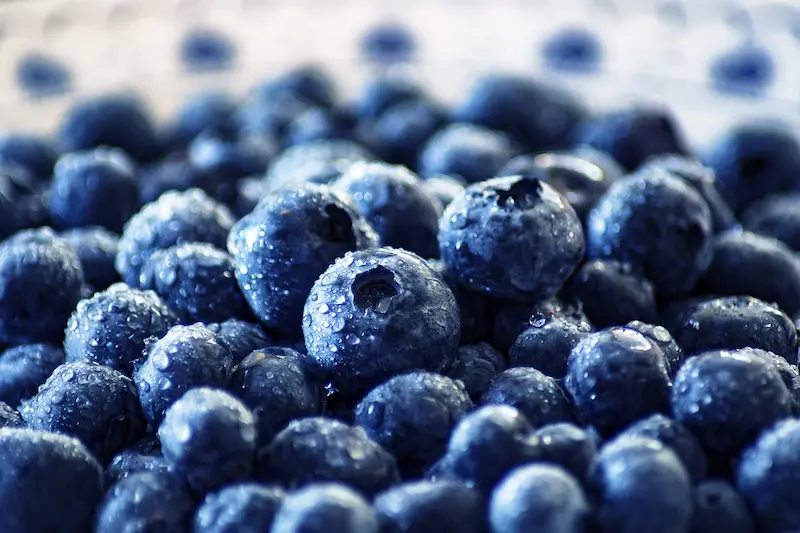
The quick and simple answer to this frequently asked question is: it depends. And it depends on the type of blueberries we have bought; whether they are organic and locally grown, or whether they are conventionally farmed.
When buying blueberries produced using conventional farming methods, it is advisable to wash them before eating them. In this type of farming, certain pesticides may be used which tend to linger on the fruit for longer. Furthermore, the conventionally grown blueberries found in supermarkets and shops in Spain for much of the year, mainly between September and March, have been imported from various countries around the world; as a result, these blueberries undergo very long journeys lasting many days, making it more likely that they may become soiled or come into contact with external contaminants during such a journey. And, of course, the health standards in certain countries are nothing like those in Spain or the European Union. So, in this case, we should wash the blueberries.
And what about organic and home-grown blueberries? Should organic blueberries be washed?
In the case of organic and home-grown blueberries, which is what we offer, it is not necessary to wash the blueberries before eating them.
Our blueberries are produced using organic farming methods, where we only use natural or organic products that leave no persistent residues on the fruit. Furthermore, by employing precision farming—where the crop is fully monitored by sensors—we ensure the optimal and effective use of these natural products. Furthermore, our organic blueberries are dispatched fresh from the field via express delivery, so in less than 24 hours they go from the farm to your home; the journey is therefore very short, with almost no intermediaries, and the risk of problems is negligible. And of course, traceability is guaranteed at all times.
Therefore, there is no need to wash our freshly harvested organic blueberries.
You should also be aware that blueberries are covered by a layer of natural wax known as pruina or “bloom” in English, which serves to protect the blueberries from insects, fungi, bacteria or other external agents. And as you can imagine, this layer of natural wax is essential for improving their shelf life for several days after harvesting in the field. So here’s another reason not to wash our organic blueberries.
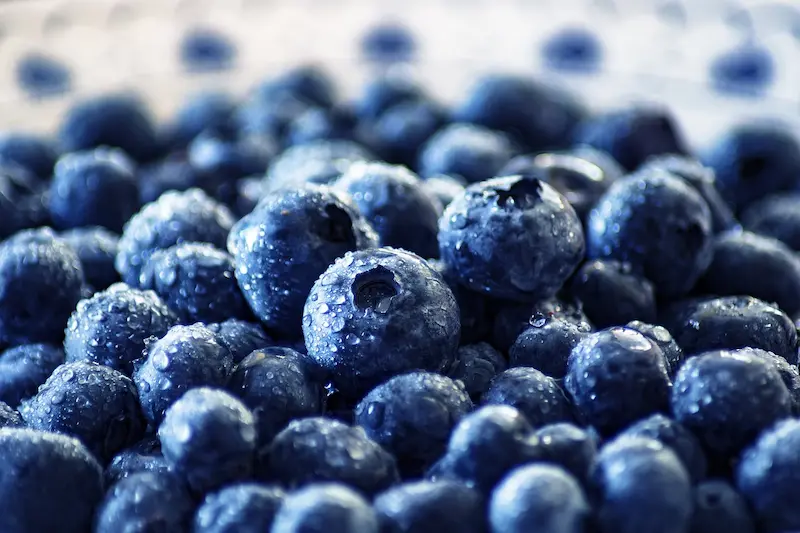
And if I do want to wash them, how should blueberries be washed?
If for any reason you wish to wash the blueberries – whether because they are conventionally grown or because they have a bit of dust or dirt on them, to give just a couple of examples – you should only wash the blueberries you are going to eat straight away.
Washing blueberries removes the natural wax that protects them and therefore reduces their shelf life. Furthermore, washing them with water can make them excessively damp. So, if you haven’t read this yet and have already washed your punnet of blueberries, you should dry them thoroughly before storing them in the fridge, to avoid excess moisture and, above all, the growth of mould, which will drastically reduce their shelf life.
Therefore, wash your blueberries a little at a time, and only those you are going to eat straight away.
Prepared and written without the use of artificial intelligence by Adrián García Villar, Agricultural Engineer from the Polytechnic University of Madrid (UPM). Membership No. 215, Official Association of Agricultural Engineers of the Principality of Asturias (COIASTUR).
References:
Juan Carlos García, Guillermo García González de Lena, Marta Ciordia Ara, (2018).