
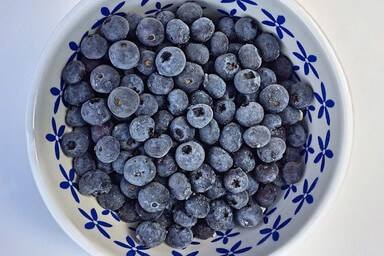
Yes, of course blueberries can be frozen, just like other berries. Freezing organic blueberries is undoubtedly the best way to continue enjoying all their properties and health benefits for several more months once the harvest season is over. When blueberries are frozen correctly, they can last for 8 to 10 months in the freezer in good condition.
What’s more, thanks to the design of our tubs, you can pop them straight into the freezer without taking up much space. However, as these are die-cut cardboard tubs, it is not advisable to keep the blueberries in them in the freezer for more than 1 or 2 months. For longer storage, you should transfer the blueberries to another airtight container such as a Tupperware box or resealable bags.
Once the harvest season is drawing to a close, it is the ideal time to place an order and freeze them. Here in the Principality of Asturias, we begin harvesting our organic blueberries in June and finish in late October or early November, depending on the weather that year.
It is recommended that frozen blueberries be consumed within the next 6 months, but they can last up to 10 months under optimal conditions. We usually use resealable bags with a sticker on which we write the date we froze the organic blueberries, so we always know how long they have been in the freezer.
In our case, we have been freezing blueberries and other red berries such as raspberries, blackberries and mini kiwis for over 30 years, almost always at the end of the season, so that we can continue to enjoy them over the coming months in desserts, smoothies or any other form of preparation. The industry uses a freezing method known as IQF. Basically, it involves spreading the blueberries or red berries out in a single layer to prevent the berries from touching one another; once spread out, they are frozen instantly at very low temperatures, allowing each berry to freeze independently so that when stored in bags, they do not stick together.
- Obviously, we don’t have an IQF system at home, but we can replicate this freezing method as closely as possible. So here are some guidelines for freezing blueberries correctly:
- Use shallow containers, such as our tubs, to prevent the blueberries from becoming too crowded; this way, when freezing them, they won’t form clumps, which can be a nuisance when defrosting.
- Before freezing the blueberries, check for any broken or overripe ones that might leak or splash onto the rest; this will prevent the released liquid from turning to ice and acting as glue for those annoying ‘frozen fruit clumps’.
- As we’ve already mentioned, for long periods of freezing, you should use airtight containers or bags, so that the blueberries aren’t damaged or burnt by the freezing air in the freezer.
By following these guidelines, you’ll be able to enjoy your frozen blueberries for many months. But there are also other questions that often spring to mind, such as:
Should I wash the blueberries before freezing them?
No. Just as we’ve already explained that there’s no need to wash our organic blueberries before eating them fresh, there’s also no need to wash them before freezing. In the case of conventional blueberries, and especially those from outside Spain, you can wash them just to be on the safe side. But remember that washing them removes the bloom, which is the natural waxy coating that covers and protects them. And if you freeze them whilst they’re wet, they’ll become mushy and it’s very likely that other problems, such as mould, will arise. So if you want to avoid these problems, buy organic blueberries.
Do frozen blueberries lose their properties?
No, not at all. If we freeze the blueberries straight away without boiling them or subjecting them to any treatment, there will be no change in their nutrient and antioxidant content. So we can freeze blueberries for several months and continue to enjoy all their properties and benefits.
What’s more, in our case, as you’re buying organic blueberries freshly picked at their peak of ripeness and which are delivered from our plantations in Asturias to your home in under 24 hours, freezing will help preserve the blueberries’ nutrients for longer.
We would have to look at extremely long freezing periods of over a year to see that the content of certain antioxidants or nutrients might begin to decrease significantly. And as things stand, there are no studies that demonstrate this with absolute certainty. Recent studies have found that, in many of the cases analysed, frozen products had a higher concentration of nutrients than fresh products.
Do defrosted blueberries go soft?
Yes, any fruit that is frozen never regains the same freshness and firmness it had when fresh. This is because when blueberries are frozen, ice crystals form inside them, causing them to expand in size. Then, when they are defrosted, they return to their original size, which is why they become softer. However, if we defrost the blueberries correctly by placing them in the fridge, they need not become excessively soft or lose all their original firmness.
So how do you defrost blueberries correctly?
Whenever you are going to defrost blueberries and want to preserve their firmness and texture as much as possible, you should do so in the fridge overnight. This way, the defrosting process is slower and more gradual, ensuring the blueberries do not lose much of their firmness. Blueberries should never be defrosted directly at room temperature, as in this case they will lose their firmness very quickly.
Prepared and written by Adrián García Villar, Agricultural Engineer from the Polytechnic University of Madrid (UPM). Membership No. 215, Official Association of Agricultural Engineers of the Principality of Asturias (COIASTUR)
References:
Juan Carlos García, Guillermo García González de Lena, Marta Ciordia Ara, (2018).
Blueberry cultivation in northern Spain.
Linshan Li, Ronald B. Pegg, Ronald R. Eitenmiller, Ji-Yeon Chun, Adrian L. Kerrihard. Selected nutrient analyses of fresh, fresh-stored, and frozen fruits and vegetables, Journal of Food Composition and Analysis, Volume 59, 2017, Pages 8–17, ISSN 0889-1575.
Villarreal-García, D., Alanís-Garza, P. A., Cuéllar-Villarreal, M. del R., Redondo-Gil, M., Mora-Nieves, J. L., & Jacobo-Velázquez, D. A. (2014). Effects of different defrosting methods on the stability of bioactive compounds and consumer acceptability of frozen broccoli. CyTA – Journal of Food, 13(2), 312–320.