
When we use the word ‘mora’ colloquially, we all think of berries characterised by their black colour and high antioxidant content. However, there is often confusion between blackberry bushes (Rubus spp.) and mulberry trees (Morus spp.) because the fruits produced by both genera bear a certain resemblance.
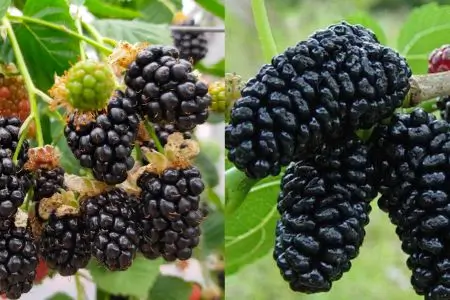
Whilst in Spanish we tend to use the word ‘moras’ to refer to both fruits, in English there is a clearer distinction, with ‘mulberry’ referring to the mulberry tree and ‘blackberry’ to the blackberry bush, these terms being used to refer to both the plants and the fruits they produce.
Before continuing, we should clarify that to make this comparison we have selected the most significant species within each genus, namely Rubus fruticosus for blackberries and Morus nigra for mulberries.
However, we would be remiss if we did not mention that there are other species of some importance, such as Rubus ulmifolius or Rubus caesius (strawberry bramble) among blackberries, and Morus rubra or Morus rotundiloba among mulberries.
And although it is true that, taxonomically speaking, both blackberry bushes and mulberry trees belong to the rose family (Rosaceae), this is where the similarities between the two genera end, as there are very notable differences between them. So, having said all that, let us continue.
Main differences between blackberries and mulberries
The most striking difference between mulberry trees and blackberry bushes is obvious. And it is none other than the size and height of each. Whilst blackberry bushes (Rubus fruticosus) can reach 3 metres in height, black mulberry trees (Morus nigra) are small trees that can easily exceed 5 metres in height without any trouble, and in some cases can reach over 20 metres in height.
On the other hand, blackberries produce flexible stems of moderate vigour. Furthermore, these stems are biennial, meaning they dry out completely in their second year. In contrast, mulberry trees develop from one or more main trunks, upon which the tree’s main framework is formed and which can remain for many years.
And these differences make sense, as all blackberries belong to the genus Rubus spp.; shrubs or bushes characterised by their small size, always with biennial, arching stems that are rather creeping in nature and generally covered in thorns or spines. In contrast, mulberry trees are grouped within the genus Morus spp.; trees characterised by very rapid growth, with very robust stems of large diameter, which we all know as trunks.
Differences between the species and the geographical distribution of blackberries and mulberries
These two genera are also very different in terms of the number of species and geographical distribution. There are only around 16 species of mulberry, distributed mainly across Asia, with some also found in Africa and North America.
Whereas the genus Rubus is one of the most extensive, with some 700 species described across the globe. It is this diversity and distribution that makes this genus highly prone to natural hybridisation, with some sources suggesting that the number of species in the genus Rubus could exceed 2,000.
Differences between blackberry and black mulberry fruits
Visually, there are no major differences between the fruits, just as there are none between blackberry bushes and mulberry trees, although there are some differences.
Mulberry fruits are usually larger and considerably longer than blackberries, although this difference is gradually diminishing thanks to new varieties such as the ARK-45 double-cropping blackberry. That said, as a general rule, mulberries look like elongated blackberries, with an almost oval shape.
When harvested, blackberries generally leave their stalk attached to the plant and the spongy central part to which it is attached, known as the receptacle, remains inside the fruit, whereas mulberries may take part of the stalk with them when picked.
Another technical difference is that, agronomically speaking, blackberries are drupes – that is, a fleshy fruit with a stone – whilst blackberries are polydrupes, as we explained in the frequently asked question “What is a drupe?”
Which tastes better, a blackberry or a mulberry?
To make this comparison, we must distinguish between classic blackberries and the newer varieties. Many of you have probably tried a wild blackberry at some point, which tend to be rather bitter with little sweetness. However, the more recent blackberry varieties are juicy and have a sweet, delicious flavour that matches or even surpasses that of mulberries, including the sweetest varieties of mulberry such as Red No.2, although mulberries always have a slightly bittersweet contrast, with a texture that is sometimes reminiscent of figs.
So nowadays, we can enjoy delicious blackberries and mulberries. Both are packed with antioxidants, minerals and vitamins, which provide great health benefits.
Are all blackberries and mulberries black in colour?
No, not at all. We mentioned at the start that when we talk about blackberries, we usually think of black fruits, but there are some exceptions in both genera that we should mention.
Amongst the mulberry trees, the most famous are colloquially known as the black mulberry (Morus nigra), the red mulberry (Morus rubra) and the white mulberry (Morus alba), although the first two turn black when their fruits are ripe. As for the white mulberry, although the wild varieties also turn a dark colour when fully ripe, the more recent varieties do retain their white colour, turning pink as they ripen.
In the case of blackberries, there are very few exceptions that are not black in colour. However, there is a species unique in the world and native to the Lapland region, which produces incredible orange-coloured fruits. This wild species is known as Rubus Chamaemorus, commonly called ‘cloudberry’ in English or ‘Moltebeeren’ in German. In Spanish, it has been translated as ‘the marsh blackberry’, which is entirely incorrect, as the correct translation should be ‘the lake blackberry’, which is what actually abounds in those latitudes, where it originates.
And now that you know all this, what would you prefer to grow? Blackberries, mulberries or both?
Whether you want blackberry plants or mulberry trees, on our website you will find top-quality plants of both species.
References:
R., Ravi. (2014).
Mulberry (Morus spp.) – A potential source of herbal medicine.
Skirvin, R. & Motoike, S. & Coyner, M. & Norton, M. (2005).
Xin Gao, Zhiyong Zhang, Xi Wang, Jiahe Qian, Libin Hu, Zheng Li, Wenlong Li, 2023.