
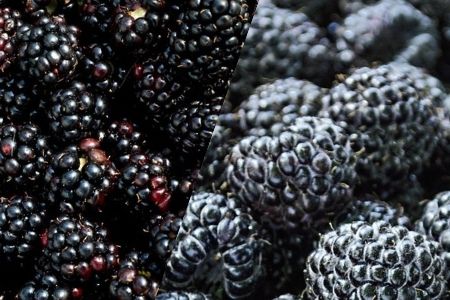
Black raspberries and blackberries are two of the berries with the highest total concentration of antioxidants, alongside aronia. Although they can be confused at first glance, black raspberries are covered in a white ‘fuzz’ that distinguishes them from blackberries, which are completely black.
The black raspberry (Rubus occidentalis) is much less well known and its cultivation is less widespread than that of the blackberry (Rubus fruticosus), which means that, in the case of the black raspberry, there are only a few very traditional varieties, mainly the one known as “Joya negra” (Black Jewel), which has a less sweet flavour and a fruit size slightly smaller than that of the blackberry. In contrast, we now have a range of new thornless blackberry varieties with an exquisite flavour, producing very juicy and enormous blackberries that are a delight to both the palate and the eye.
Another difference between these drupes is that when we pick blackberries, just like other blackberries, they detach from their core (receptacle), leaving the inside of the fruit hollow, whereas with blackberries, the core remains inside the fruit when we pick them from the plant. Where both fruits do agree is in their low sugar and calorie content, making them ideal for adding to any diet.
But if there is one thing that sets black raspberry and blackberry plants apart, it is their incredible concentration of antioxidants such as anthocyanins, flavonoids and essential acids, which protect our bodies from oxidative damage caused by free radicals, with all the great benefits that entails, as well as possessing anti-inflammatory and anti-cancer properties.
Furthermore, both black raspberry blackberry and blackberry plants are very hardy and resilient, making them very easy to grow and ideal for our vegetable patches, gardens or terraces.
Prepared and written by Adrián García Villar, Agricultural Engineer from the Polytechnic University of Madrid (UPM). Membership No. 215, Official Association of Agricultural Engineers of the Principality of Asturias (COIASTUR).
References:
Juan Carlos García, Guillermo García González de Lena, Marta Ciordia Ara, (2014).
Kostecka-Gugała, Anna, Ledwożyw-Smoleń, Iwona, Augustynowicz, Joanna, Wyżgolik, Gabriela, Kruczek, Michał and Kaszycki, Paweł.