
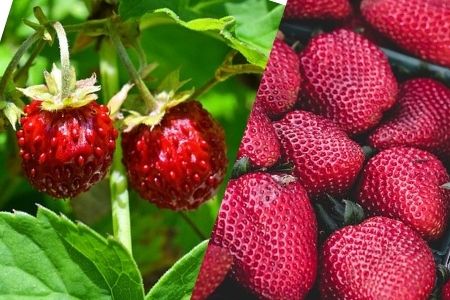
Strawberries can be classified according to the size of their fruit, their light requirements or their need for hours of winter chill, resulting in different types of strawberries. Based on the size of the strawberries and in more colloquial terms, we can distinguish three types of strawberries: the smallest, known as wild strawberries, the quintessential variety of which is Reina de los Valles; the medium-sized ones, known simply as strawberries; and the most recent variety, with very large fruit, known as Fresón.
On the other hand, strawberries are classified agronomically according to their light requirements, known as photoperiod, or their chill hour requirements. In this classification, we can distinguish three groups of strawberries:
.Short-day: these require photoperiods of less than 14 hours of light to set fruit and a minimum of 500 chill hours of winter dormancy. Varieties in this group usually produce a single crop per year, in spring-summer.
.Long-day: also known as everbearing, these are varieties that need long days (more than 14 hours of light) to form flower buds, so they produce in summer/autumn. One of the most characteristic varieties in this group is Mara des Bois, one of the most aromatic strawberries in existence, or the Selva variety of large strawberries. This group also includes our beloved wild strawberries and the novel and incredible strawberries with pink flowers.
.Day-neutral: these are the most recent to reach the market. They are not affected by day length or winter chill requirements, and when the ambient temperature exceeds 12 degrees (usually from spring to autumn), they begin to flower and subsequently produce strawberries, with the advantage that some varieties, such as San Andreas, have a high remontancy and produce strawberries continuously for 4 to 10 months depending on the local climate; consequently, we have a much more consistent and extended harvest. This makes them ideal for both professional and amateur cultivation.
Prepared and written by Adrián García Villar, Agricultural Engineer from the Polytechnic University of Madrid (UPM). Membership No. 215, Official Association of Agricultural Engineers of the Principality of Asturias (COIASTUR).
References consulted:
Morales A., Carmen Gloria and Vargas S., Sigrid (eds.) (2017).
Juan Carlos García Rubio (2015).