
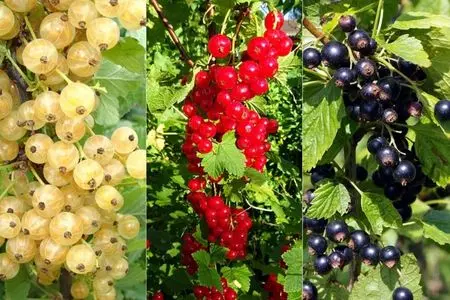
The main types of cultivated currants are redcurrants (Ribes rubrum), whitecurrants (Ribes sativum), blackcurrants (Ribes nigrum) and golden currants (Ribes aureum and Ribes odoratum), which have yellow flowers.
Of lesser importance are other currant species, such as the alpine redcurrant (Ribes alpinum), native to Europe, and other American species such as the wax currant (Ribes cereum), the stinking currant (Ribes bracteosum), the mountain pink currant (Ribes nevadense) or the red-flowered currant (Ribes sanguineum), which is grown for ornamental purposes.
Are all currant plants the same size?
Well, no! When it comes to the size of currant plants, we can distinguish between two different types; on the one hand, we have the classic currants, which are medium to tall and can reach up to 2 metres in height. And on the other hand, the newest and most recent varieties are the dwarf currants, which you can of course find in our nursery. Dwarf currants are much more compact in size, not exceeding 80 cm in height, and are ideal for urban cultivation in pots.
Are there sweet currants?
Yes, thanks to the brand-new varieties of dwarf redcurrant® and sweet blackcurrant®, blackcurrant cultivation has changed forever, and once you’ve tried one, you won’t want to stop. With these varieties, you can enjoy exquisite blackcurrants with a spectacular flavour, as well as reaping the countless benefits of eating blackcurrants, which are a real powerhouse of antioxidants.
On the other hand, when it comes to the flavour of classic currants, the redcurrant is the sweetest of all and therefore the easiest to pop into your mouth and eat fresh, although it will always have that characteristic hint of tartness typical of currants. In contrast, the traditional blackcurrant, or cassis, is quite bitter due to its high concentration of antioxidants, and it is not usually eaten fresh; instead, it is most commonly consumed in juices, smoothies, desserts or in freeze-dried form.
White and green currants, whose colours are caused by a genetic mutation that prevents the accumulation of antioxidants, have a less bitter taste than blackcurrants but are more bland than redcurrants and are therefore usually consumed in processed products.
At our nursery, you can find the latest varieties of currants in all colours and sizes: red, black, green, white, sweet and dwarf.
Prepared and written by Adrián García Villar, Agricultural Engineer from the Polytechnic University of Madrid (UPM). Membership No. 215, Official Association of Agricultural Engineers of the Principality of Asturias (COIASTUR).
References consulted:
Sharma, Girish & Lata, Suman & Yadav, Ashok. (2020).
Temperate Fruit Crop Breeding: Domestication to Cultivar Development (pp.255-279). Chapter: 8, Publisher: Jaya Publishing House. (Article in English).
08:00am – 18:00pmLegal NoticeSales PolicyCookie PolicyCookie SettingsPrivacy PolicyARÁNDANOS EL CIERRON © 2026 | ALL RIGHTS RESERVED