
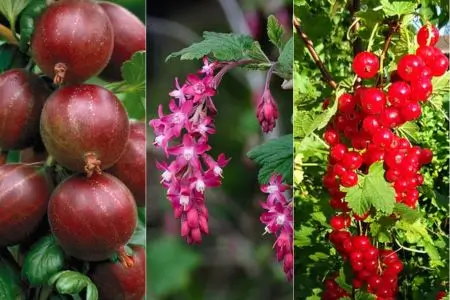
Currants are among the most diverse berry fruits. Within the genus Ribes, there are between 150 and 200 currant species, which means there are many different types of currants, varying in size, colour and even purpose, as some species are purely ornamental and are known as winter currants.
Currants are the fruits produced by plants known as currant bushes, and they occur naturally in cold and temperate regions of the Northern Hemisphere, with some species extending further south, such as into North Africa and even as far as Patagonia.
Within the genus Ribes, we can distinguish three main groups of currant bushes: edible currants, meaning those that produce fruit in clusters; winter currants, which do not produce edible fruit; and gooseberries, which produce individual fruits rather than clusters. It should also be mentioned that some flowering currants have spines, so one could even speak of a fourth group, commonly referred to in English as flowered gooseberries, of which we will mention a few examples later.
As for the main cultivated currant types worldwide, the most important are red currants (Ribes rubrum), black currants (Ribes nigrum) and gooseberries (Ribes uva-crispa). However, there are more than 100 officially accepted currant types, which can be distinguished by their place of origin, fruit colour, plant size, flowering habit and even aroma.
What types of currants are there in the world?
As already mentioned, there are more than 150 currant species, with around 100 currant types officially accepted. The main currant types of particular relevance are the following:
Red currant (Ribes rubrum) is the species from which most commercial varieties originate and is the most widely grown currant crop in the world, with production well exceeding 600,000 tonnes. These shrubs are characterised by producing beautiful clusters of deep red berries, usually made up of 10 to 15 currants. One of the best-known varieties is Junifer, one of the few red currant cultivars considered suitable for all climates.
Black currant (Ribes nigrum), from which most modern cultivated varieties derive, is characterised by being a very vigorous and hardy shrub with strong growth, producing berries with a high concentration of antioxidants, such as the innovative sweet black currant “Black Marble”. Black currant bushes are also known for being highly aromatic plants.
White currant (Ribes sativum) refers to shrubs that are generally smaller and less productive than the previous types, whose main characteristic is their translucent clusters of currants, with a mild and less acidic flavour.
Northern black currant (Ribes hudsonianum), native to North America, grows in moist woodland areas. These plants are characterised by a strong scent and very attractive inflorescences with clusters of up to 50 flowers.
Flowering currant (Ribes sanguineum) is the best-known ornamental currant species, from which spectacular varieties such as “Amore” and “Oregon Snowflakes” have been developed. These plants are characterised by their compact habit and dense flowering, making them a real visual highlight.
Rock currant (Ribes petraeum) is so named because it grows among rocks and in mountain areas of western and central Europe, usually in the shade of trees such as beech, pine and fir. These shrubs, which can grow up to 3 metres tall, produce red fruits with a very acidic flavour. In Spain, it occurs along the Cantabrian-Pyrenean axis and extends into the northern Iberian System.
Skunk currant (Ribes glandulosum) is another North American species, named after the strong and unpleasant smell released by its ripe fruit. These fruits are especially unusual because they are covered with glandular hairs, hence the technical name glandulosum.
Golden currant (Ribes aureum) is famous for its beautiful golden-yellow flowers. These currant bushes are also known as buffalo currant or clove currant and are native to North America.
Wax currant (Ribes cereum), native to western North America and also known as Indian currant, is characterised by its fragrant flowers and by producing red-orange fruits with a mild, waxy flavour.
Alpine currant (Ribes alpinum) is one of the best-known wild currants in northern Europe, where it is mainly found. These bushes can grow up to 2 metres tall and produce small clusters of translucent red berries with a rather bland flavour. Unlike commercial varieties, their fruit clusters rarely contain more than 5 or 6 berries. It is also present in Spain, for example in the Sierra de Guadarrama.
Laurel-leaved currant (Ribes laurifolium) is native to China, specifically to Guizhou, western Sichuan and Yunnan. These currant bushes are low-growing, reaching no more than 1 metre in height, and are characterised by their evergreen laurel-shaped leaves, which give the plant its name.
Sierra currant (Ribes nevadense), native to the mountains of California, grows at altitudes ranging from 950 to 3,000 metres above sea level, which explains both its common and botanical name. It has very attractive pink flowers and produces small bluish-black fruits.
What types of gooseberries are there in the world?
Gooseberries, on the other hand, are characterised by their thorny stems and, unlike currants, they do not produce fruit in clusters but as individual berries. There are also some ornamental types. The main gooseberry types are the following:
European gooseberry (Ribes uva-crispa) is the gooseberry par excellence, the species from which most commercial varieties originate, with fruits mainly in red, yellow or green. Very often, when we talk about gooseberries, it is taken for granted that they all belong to the European species, but in fact this is not the only one, and below we mention other gooseberries of greater or lesser importance.
Ribes hirtellum, known as the American gooseberry or simply wild gooseberry, is native to Canada and the northern United States. It is a very important species because, unlike its European relative (Ribes uva-crispa), it is resistant to American gooseberry mildew (Podosphaera mors-uvae), and thanks to it, much more resistant new varieties have been developed.
Ribes divaricatum, native to North America, is known as the coastal black gooseberry or Worcesterberry. Its common name clearly comes from the colour of its fruit, as these shrubs produce black-violet gooseberries.
Ribes inerme is known as white-stem gooseberry and is native to western North America. These bushes have a shrub-like habit and produce small hairless fruits that may be greenish, black or purple.
Ribes lacustre, known as prickly swamp gooseberry or swamp black gooseberry, is an extremely hardy currant species widely distributed across North America. Its older stems develop a cinnamon tone, and although it is a gooseberry, its fruits are very similar to black currants.
Ribes lobbii is one of the most spectacular gooseberry species thanks to its striking fuchsia flowers, with fan-shaped pinkish-white petals. Hence its common names fuchsia-flowered gooseberry or gummy gooseberry. These currant bushes grow only on the western coast of North America. Their fruits, however, are reddish-brown, covered in glandular hairs, and have a very unpleasant taste.
Ribes montigenum is one of the gooseberries with the most heavily armed stems, bearing groups of 1 to 5 sharp spines at regular intervals all along the stems. This North American species is known as mountain gooseberry or western gooseberry. Its red fruits have a mild and pleasant flavour.
Ribes pinetorum is known as orange gooseberry because of the colour of its flowers; however, its fruits are purple and it is often confused with physalis because of their colour. These gooseberry bushes are native to Arizona and New Mexico and grow at elevations between 1,900 and 3,000 metres.
Ribes speciosum is another of the most spectacular gooseberry species thanks to its tubular flowers, formed by scarlet sepals with glands and four red petals inside. In addition, the flowers have red stamens and stigmas that project from the mouth of the flower, each reaching up to 4 cm in length, making them truly spectacular. This species, native to central and southern California, is also known as fuchsia-flowered gooseberry.
Ribes triste is a currant species known as northern red currant or swamp red currant, and it has the particular feature that, despite being a gooseberry, it produces small clusters of red fruits resembling true currants. It is a shrub native to North America and parts of Asia, including Russia, China, Korea and Japan. Indigenous peoples used its raw fruits to make jams and jellies, and sometimes mixed them with other berries such as rosehips and cranberries.
Ribes oxyacanthoides is known as Canadian gooseberry, which already gives an idea of its northern origin. These shrubs can reach almost 2 metres in height and produce tasty fruits that may be reddish, greenish, purple or black.
Finally, there are some extremely little-known currant species, such as Ribes maximowiczii, formerly known as Ribes jessoniae, native to western China and discovered by a Russian traveller in 1885.
So, after reading this overview of the different currant types, you can already imagine the enormous diversity of currants spread across a large part of the planet. Many of them can also be found on our website.
Prepared and written by Adrián García Villar, Agricultural Engineer from the Polytechnic University of Madrid (UPM). Registered No. 215, Official Association of Agricultural Engineers of the Principality of Asturias (COIASTUR).
Bibliography consulted: