
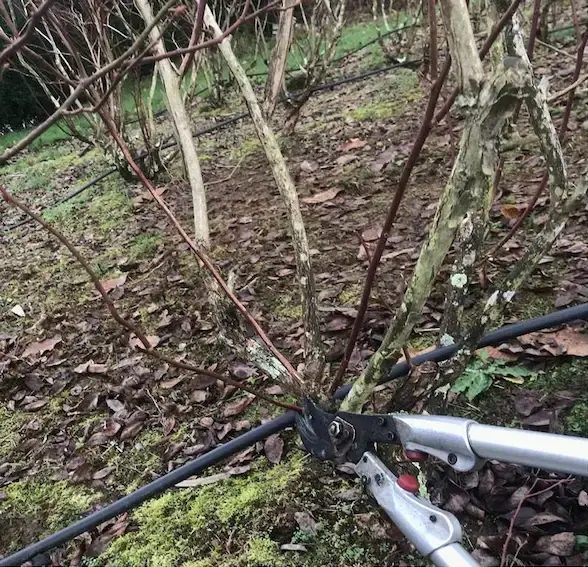
The main purpose of pruning blueberry plants is to keep the plant balanced between its vegetative and reproductive growth. In other words, the aim is to maintain a balance between productive branches and renewal canes, which are absolutely essential every year in order to keep producing high-quality fruit.
However, blueberry pruning will vary depending on the age of the plant, becoming more complex as the plant matures.
When is the right time to prune blueberries?
The best time to prune blueberry plants, like most fruit crops, is during winter, while the plant is dormant, that is, from November to March.
Pruning young blueberry plants
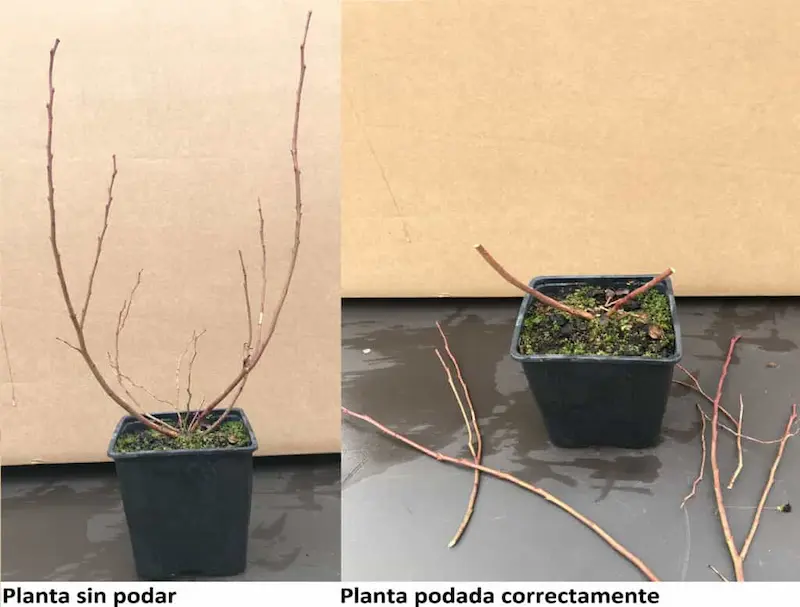
For small plants in 1-litre pots, which are usually around one year old, we should make sure to remove all flower buds so that all the plant’s energy is directed towards root development and the growth of strong new shoots that will produce high-quality fruit in the coming seasons.
To do this, the blueberry plant should be pruned quite hard, cutting the vigorous shoots back to around 10–15 cm from the base of the stem and removing the rest of the weak shoots.
Pruning larger blueberry plants
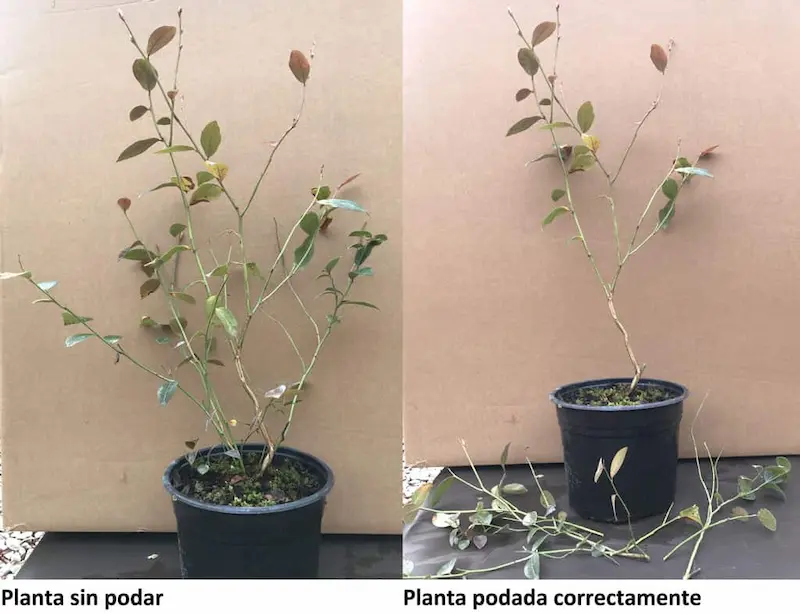
For larger blueberry plants in 4-litre pots, fruit production can already begin immediately, but it is still important to maintain a balance between the above-ground growth and the root system.
In this case, we carry out a lighter pruning by removing all flower buds from weak branches and from branches close to the ground, leaving only the flower buds located on the strongest shoots. In this way, we achieve a good balance and the plant can produce quality blueberries without affecting its growth.
Step by step: how to prune an adult blueberry plant
The easiest way to identify which branches to cut is by their colour. Older branches tend to be greyish, while younger ones are reddish or green depending on the variety.
We cut the oldest branches of the blueberry plant at a height of around 40–50 cm above ground level, because below that height we are not interested in producing fruit. Sometimes these old branches already have a strong new shoot growing from them, in which case, instead of cutting at 50 cm, we cut just above the new shoot so that it can be kept and developed. These cuts are where new vigorous shoots will emerge.
Below we explain how to prune a mature blueberry plant. For this, we carry out what is known as renewal pruning. As mentioned earlier, we need to remove some of the oldest branches in order to encourage the growth of vigorous new shoots that will produce fruit in the following years.
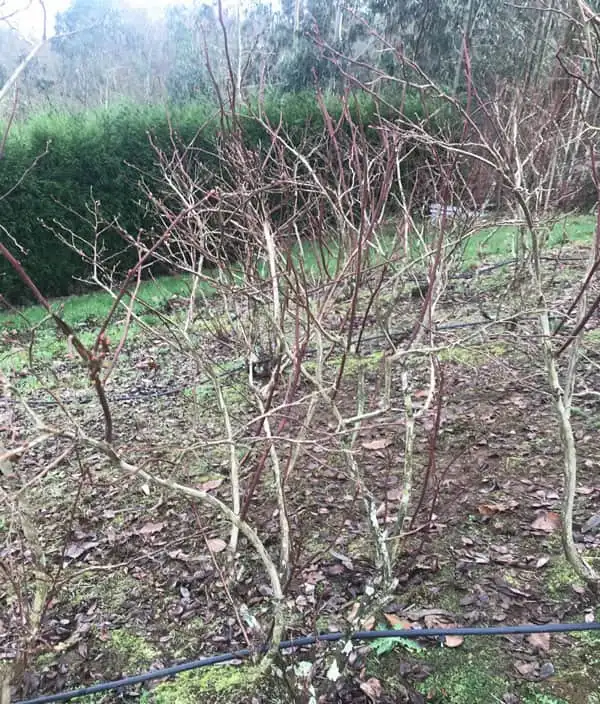
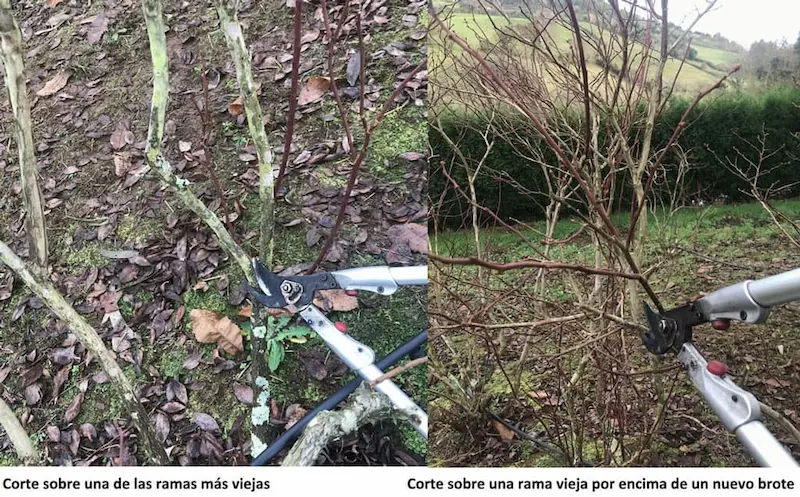
To encourage the growth of these new shoots, the inside of the bush canopy should be kept open and free of branches so that sunlight can enter properly. When there is not enough air circulation and light inside the canopy, the new shoots tend to be weak and lack vigour, making them unsuitable for producing quality fruit.
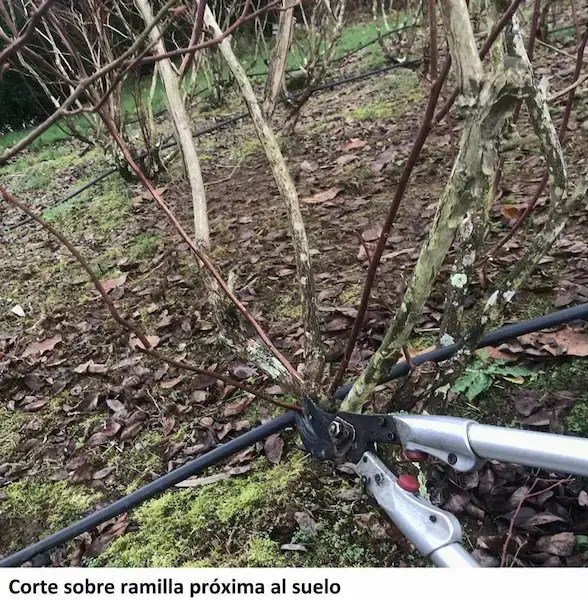
Once all the old branches have been removed, we continue with more detailed pruning. First, we remove all the small twigs on the blueberry plant that are close to the ground, below 50 cm, since fruit produced near the ground is generally of poorer quality.
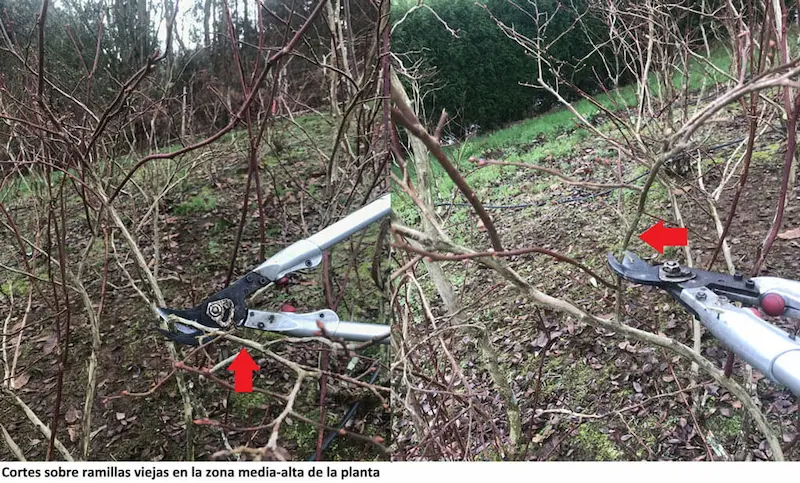
We then continue pruning in the middle and upper parts of the blueberry plant, removing all dry or old twigs where there are hardly any flower buds. As before, colour is a useful guide here: these older twigs will usually be greyish, while the younger ones will be reddish.
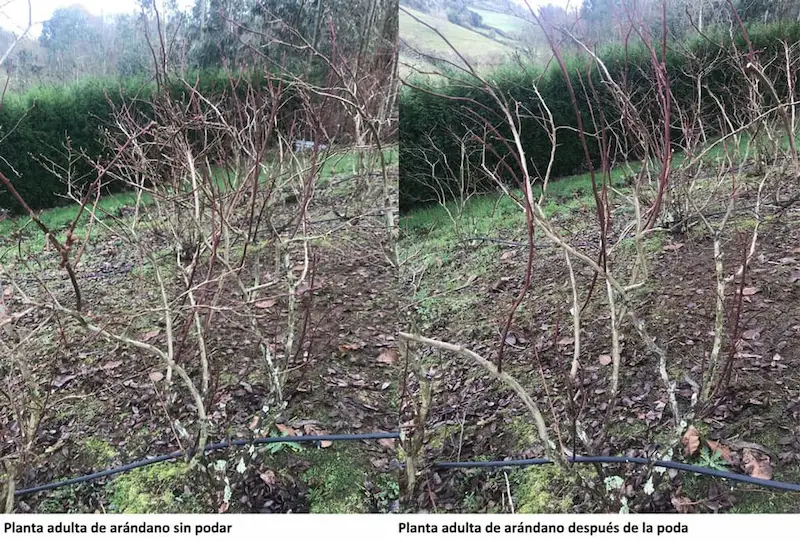
At the tips of these younger twigs, we can observe the flower buds, and it is on these that high-quality fruit will be produced. Once pruning has been completed correctly, we will notice that the dominant colour in the middle and upper part of the plant is reddish, which indicates that most of the twigs are young.
If you would like more information on how to grow these plants, you can read other posts on our blog, consult the books we have available, or get in touch with us through the contact form or telephone numbers shown on our website. You are also always welcome to visit us at our nursery.
Prepared and written by Adrián García Villar, Agricultural Engineer from the Polytechnic University of Madrid (UPM). Registered No. 215, Official Association of Agricultural Engineers of the Principality of Asturias (COIASTUR).
Bibliography consulted: